Content
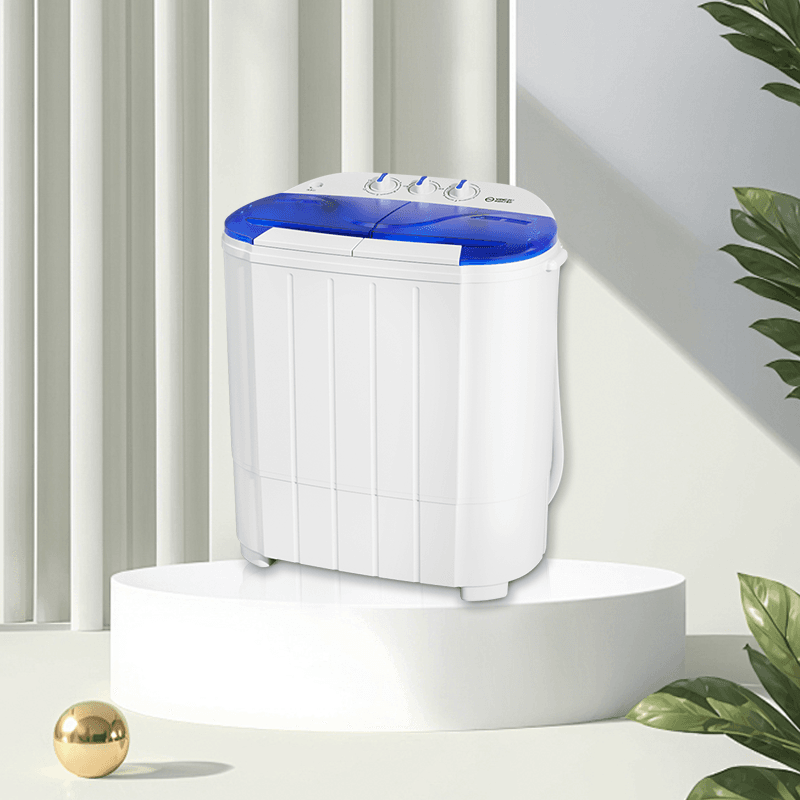
A semi-automatic mini washing machine is a compact laundry appliance built around two separate tubs, one for washing and one for spin drying, that a user operates by moving clothing between chambers and setting wash time manually with a dial. This twin tub washing machine format trades full automation for a smaller footprint, lower water use per cycle, and straightforward mechanical controls, which is why it has become a common choice for apartments, student housing, recreational vehicles, and households that want a secondary washer for small loads. The core advantage of a mini washing machine in twin tub form is space and control rather than one touch convenience, since the operator decides when to transfer laundry between tubs instead of relying on a single automated program.
Compared with a full-size automatic machine, a semi-automatic mini washing machine generally fits into a corner of a bathroom, balcony, or utility closet, runs on a standard household outlet, and completes a wash and spin cycle for a partial load in well under an hour. The wash tub and spin tub work independently, so a household can wash a small batch of clothing while a previous load finishes spinning nearby, which is not possible on a single drum automatic machine. Because the mechanism is simpler than a fully automated washer, everyday operation and basic upkeep are also easier for a household to manage without outside help.
The sections below walk through current demand trends for mini and twin tub washing machines, how the twin tub mechanism works, how this format compares with full-size and portable single-tub alternatives, and practical guidance for matching a machine to a specific living situation, from a dorm room to a recreational vehicle.
Industry research from firms including Market Research Future and Future Market Insights places the global mini washing machine market at approximately 0.9 billion US dollars in 2025, with most published forecasts pointing toward continued growth into the 1.5 to 1.6 billion dollar range by the mid 2030s. Within this broader mini washing machine category, several regional market studies have identified the semi-automatic twin tub segment as one of the faster growing formats, with some studies citing double digit annual growth rates that outpace the roughly 5.5 to 6 percent compound annual growth rate reported for the mini washing machine category as a whole. A 2025 to 2026 washing machine market review from Mordor Intelligence also found that conventional, non connected washers, a category that includes semi-automatic and twin tub designs, still accounted for about 70 percent of the broader global washing machine market by value, even as smart connected models continue to expand from a smaller base.
The chart above traces a composite growth path for the global mini washing machine market from 2025 through 2035, drawing on published estimates from firms including Market Research Future and Future Market Insights. Market size in this composite view starts near 0.9 billion US dollars in 2025 and is projected to pass the 1 billion dollar mark within the next two to three years, before continuing a steadier upward path toward the 1.5 to 1.6 billion dollar range by the middle of the next decade. The overall compound annual growth rate implied by this trajectory sits roughly in the 5.5 to 6 percent range, which is modest next to some faster moving appliance categories but consistent across multiple independent forecasts. Several of the underlying reports point to the same core drivers behind this curve, including smaller average household sizes, a rising number of single person and student households, and continued growth in recreational vehicle and mobile living arrangements. Within this broader mini washing machine trend, the semi-automatic twin tub segment has been highlighted in some regional studies as growing faster than the category average, since it remains one of the more accessible entry points into compact laundry equipment. For an OEM or ODM manufacturing partner, a steady multi year growth curve like this one generally signals a stable rather than a short lived seasonal opportunity in the mini washing machine category.
Market segmentation is useful, but it helps to know who actually buys and runs these machines day to day. A buyer feedback review of portable and twin tub washing machine owners found that recreational vehicle owners made up roughly a third of the surveyed buyer base, while apartment dwellers represented close to a fifth, with the remaining share spread across dorm residents, secondary washer buyers, and small scale commercial users such as guesthouses.
The chart above summarizes findings from a buyer feedback review of portable and twin tub washing machine owners, focused on who actually buys and uses these compact machines day to day. Recreational vehicle owners made up roughly a third of the surveyed buyer base, which lines up with the format's lower water use, light weight, and ability to run on limited power that suits mobile and off grid living. Apartment dwellers represented close to a fifth of buyers, a group generally drawn to the smaller footprint and the option to run a wash cycle without full-size laundry hookups. The remaining share, grouped here as other households and small spaces, includes dorm residents, households running a secondary washer for small or delicate loads, and small scale commercial users. This distribution suggests that twin tub and portable mini washing machines serve a genuinely varied buyer base rather than a single narrow niche, which matters for how a manufacturer plans product features and packaging. Because RV owners and apartment dwellers together account for roughly half of this buyer base, features such as compact dimensions, low noise operation, and manageable weight remain relevant design priorities across the category.
A twin tub semi-automatic mini washing machine separates the wash and spin functions into two independent chambers within a single housing. The wash tub uses a rotating pulsator disc at its base to move water and detergent through the fabric, loosening dirt through mechanical action rather than a single sealed drum cycle. Once the wash and rinse steps are complete, the operator lifts the laundry by hand or drains the wash tub and transfers the load into the adjacent spin tub. The spin tub then rotates at high speed around a vertical axis, using centrifugal force to push water out through perforations in the basket wall and down a separate drain line. A mechanical timer dial, rather than a digital control board on most base models, lets the user set wash and spin duration directly, which keeps the control layout simple and easier to service. Because the two tubs operate independently, some households run a wash cycle in one tub while spinning a previous load in the other, which shortens total laundry time for small loads even without full automation.
The diagram above breaks down the main functional zones of a typical twin tub semi-automatic mini washing machine in a simplified three dimensional view. On the left side of the housing sits the wash tub, where the pulsator moves water and detergent through the load during the wash and rinse stages. The smaller chamber on the right is the spin-dry tub, which uses a perforated basket and a motor to remove excess water once washing is finished. Between the two tubs, the control dial lets the operator set timing for each function independently, which is the defining trait of a semi-automatic design rather than a fully automatic one. A lid covers each chamber during operation to reduce splashing and keep the wash area contained, while a drain hose at the base routes waste water away from the unit after each cycle. The compact footprint shown here, with both tubs built into a single housing, is what allows this washing machine format to fit into small apartments, dorm rooms, and mobile living spaces where a full-size machine would not fit.
Choosing among a full-size automatic machine, a semi-automatic twin tub mini washing machine, and a portable single-tub washer starts with understanding how their tub structure and operation style differ. The table below lines up the three formats on the factors that matter most when matching a washing machine to a specific living space.
| Comparison of common washing machine formats by tub structure, typical capacity, and best-fit household setting. | ||||
| Format | Tub Structure | Typical Capacity | Operation Style | Best Suited For |
| Full-Size Automatic Washing Machine | Single tub, integrated wash and spin | 6 to 10 kg per load | Fully automatic, one program cycle | Larger households with dedicated laundry space |
| Semi-Automatic Twin Tub Mini Washing Machine | Two separate tubs, wash and spin | 3 to 6 kg combined | Manual transfer between tubs, dial based timing | Small apartments, dorms, and households wanting manual control |
| Portable Single-Tub Mini Washer | One compact tub, wash with light spin | 1 to 3 kg | Simplified controls, minimal footprint | RVs, travel, and small item washing |
Beyond the table above, it helps to see how the three formats trade off against each other visually. The radar chart below is a general design comparison rather than a laboratory measurement, scoring each format from 1 to 5 across five practical dimensions that matter to everyday users.
The chart above compares three common washing machine formats, a full-size automatic machine, a semi-automatic twin tub mini washing machine, and a portable single-tub mini washer, across five practical dimensions rather than laboratory measurements. Space efficiency and portability score highest for the portable single-tub and semi-automatic twin tub formats, reflecting their smaller housings and lighter overall weight suited to apartments and mobile living. Load capacity per cycle tells the opposite story, with full-size automatic machines handling considerably larger loads than either mini format, which is why larger households with steady laundry volume still tend to favor a full-size unit. Manual control is highest for the semi-automatic twin tub design, since the operator sets wash and spin timing separately rather than relying on a single automated program, a trait some users value for delicate fabrics or partial loads. Water efficiency per cycle tends to favor both mini formats over full-size machines simply because the tubs hold less water to begin with, though actual water use also depends on how many cycles a household runs in a week. Read together, the profile suggests that a twin tub semi-automatic mini washing machine sits in a middle position, offering more manual control and space savings than a full-size machine while retaining a higher load capacity than the smallest portable single-tub washers.
Demand for semi-automatic mini washing machines is not evenly spread across the world. Industry segmentation estimates put Asia Pacific at close to 45 percent of global demand for this format, with North America and Europe making up most of the remaining share.
The chart above shows an approximate regional breakdown of demand for semi-automatic mini washing machines, based on industry segmentation estimates rather than a single verified count of every market. Asia Pacific accounts for close to 45 percent of demand in this segmentation, a pattern consistent with high urban density, smaller average living spaces, and a large manufacturing base for compact appliances across the region. North America follows at around a quarter of demand, driven largely by apartment living, recreational vehicle ownership, and college housing rather than by any single dominant use case. Europe sits near a fifth of demand, reflecting a mix of compact urban housing and long standing consumer familiarity with smaller capacity appliances. The remaining share, spread across Latin America, the Middle East, Africa, and other markets, is smaller in absolute terms today but has been highlighted in several market reports as an area of gradual growth as urban housing stock expands. For a manufacturer or sourcing partner, this distribution is useful mainly as a directional signal, since actual demand in any single country depends heavily on local housing patterns and appliance ownership habits that a regional average cannot fully capture.
The right washing machine format depends less on brand and more on where and how it will actually be used. The four situations below cover most of the buyer base for semi-automatic mini washing machines and twin tub washing machines described in the usage data above.
Shared laundry rooms are not always available or convenient, and a compact semi-automatic twin tub mini washing machine gives a student a private option for small loads of clothing, bedding for a single bed, or workout gear, within a footprint that fits under a desk or in a closet corner.
For a one or two person apartment without dedicated laundry hookups, a mini washing machine offers a middle ground between hand washing and a trip to a laundromat, handling everyday loads on a balcony, in a bathroom, or in a kitchen corner near a water source.
Recreational vehicles and boats have limited water storage and electrical capacity, and the twin tub format's lower water use per cycle and standard household voltage requirement make it a practical fit for mobile living compared with a full-size residential machine.
Even households with a full-size automatic machine sometimes add a compact twin tub unit for delicate items, small batches of baby clothing, or quick same day loads, running it alongside the main washer rather than replacing it.
Cixi City Yongda Electronics Co., Ltd. is based in Cixi, within the Ningbo region of Zhejiang Province, China, an area recognized as a long standing manufacturing base for small home appliances with a well developed local supply chain. The company was established in 2003 and has spent more than two decades manufacturing home appliances, reaching an annual sales scale of around 100 million while maintaining what the company describes as stable, consistent product quality paired with practical value for buyers.
As a OEM washing machine supplier and ODM mini washing machine company in China, Yongda Electronics develops semi-automatic mini washing machines and twin tub washing machine designs for partners exporting to markets across multiple regions, with foreign trade currently accounting for more than half of total factory output. Product packaging for these washing machines is sized and designed with export logistics in mind, so carton dimensions and container loading patterns are planned together rather than treated as a separate step late in production.
Internal staffing at the factory is structured to flex around different customer requirements, which supports comparatively fast turnaround on production orders. The factory's location is also close to Beilun Port, roughly 35 kilometers away, which shortens the logistics chain between the production line and outbound shipping for international buyers sourcing mini washing machines, semi-automatic twin tub washing machines, and related compact laundry appliances.
A semi-automatic mini washing machine, often built as a twin tub washing machine, requires the user to transfer laundry between a wash tub and a separate spin tub and to set timing manually with a dial. A fully automatic machine runs wash, rinse, and spin as one continuous programmed cycle inside a single drum without the operator moving the load partway through.
Combined wash and spin capacity on most twin tub mini washing machines generally falls in a 3 to 6 kilogram range, though the wash tub and spin tub are usually sized somewhat differently, so checking both tub capacities separately gives a more accurate picture of what a single load can hold.
A semi-automatic mini washing machine can work for a small family handling delicate items, children's clothing, or overflow laundry between larger wash days, though households with continuous higher laundry volume typically still rely on a full-size machine as their primary appliance.
Because the wash and spin tubs on a mini washing machine hold less water by design, a single cycle typically uses less water than a full-size drum, though total household water use also depends on how many cycles are run over a week rather than on tub size alone.
Practical factors include the combined wash and spin capacity relative to typical load size, overall footprint and weight for the available space, drain hose length, and how straightforward the control dial is to operate day to day.
Twin tub and portable mini washing machines are commonly used in RVs and similar mobile living spaces because of their lower water use per cycle and standard household voltage requirements, though available onboard water storage and power capacity should still be checked against the specific model before installation.
Choosing between a full-size automatic machine, a semi-automatic twin tub mini washing machine, and a portable single-tub washer generally comes down to available space, typical laundry volume, and how much manual involvement a household is comfortable with. The market data throughout this guide points to steady, multi year growth across the mini washing machine category, with the semi-automatic twin tub format standing out as a common entry point for apartments, dorms, RVs, and secondary household use.



 English
  Español
  عربى
عربى 